
Spinal Mobility for Performance and Injury Prevention in Fremantle
- Dr Nathan Bridger

- Jan 1
- 8 min read
Updated: 3 days ago

Spinal mobility plays a critical role in how we move, train, and perform, especially as we get older. Many active Australians notice stiffness or reduced movement after their thirties, which can affect strength, reaction time, and injury risk. At North Fremantle Chiropractic, we work with active adults from North Fremantle, Fremantle, East Fremantle, Palmyra, Bicton, Mosman Park and surrounding Perth suburbs who want to move better and stay injury-free. Spinal mobility is often the missing piece in long-term performance and resilience. This guide breaks down how spinal mobility works and how to improve it so you can stay active, resilient, and pain-free.
Table of Contents
Key Takeaways
Point | Details |
Understanding Spinal Mobility | Spinal mobility is crucial for movement efficiency and injury prevention, involving four primary types of motion: flexion, extension, lateral flexion, and rotation. |
Impact on Athletic Performance | Optimal spinal mobility enhances strength, speed, and agility, enabling athletes to perform movements effectively and reduce injury risks. |
Risks of Poor Mobility | Limited spinal mobility can lead to increased injury susceptibility and chronic pain due to compensatory movement patterns. |
Improving Spinal Mobility | Incorporate daily gentle spinal mobility exercises and professional assessments to enhance flexibility and maintain a healthy musculoskeletal system. |
Defining spinal mobility and key concepts
Understanding spinal mobility involves exploring how your spine moves and functions across different planes of motion. The spine is not just a rigid column but a dynamic structure capable of complex movements that are critical for everyday activities and athletic performance. Spinal mobility measurements typically assess the range of motion through specific tests like cervical rotation, lateral flexion, and total spine flexibility.
At its core, spinal mobility encompasses four primary movement types: flexion (bending forward), extension (bending backward), lateral flexion (side bending), and rotation. Each of these movements requires precise coordination between vertebrae, muscles, ligaments, and intervertebral discs. When these components work harmoniously, you can move smoothly and efficiently, reducing your risk of injury and enhancing overall physical performance.
Physically active individuals in North Fremantle understand that optimal spinal mobility isn’t just about being flexible - it’s about maintaining a balanced, strong musculoskeletal system. Athletes and weekend warriors depend on a spine that can smoothly transition between different movements, whether that’s during a surf session at Leighton Beach or a weekend football match. Poor spinal mobility can lead to compensatory movement patterns, increased strain on joints, and potentially chronic pain.
Pro tip: Incorporate daily gentle spinal mobility exercises like cat-cow stretches and controlled rotational movements to maintain your spine’s range of motion and prevent stiffness.
Types of spinal movement and their roles
The human spine is engineered for complex, multidirectional movement, with each movement type serving a unique biomechanical purpose. Flexion involves bending forward, allowing activities like touching your toes or picking up something from the ground. Extension represents backward bending, crucial for movements like standing upright or performing back extensions during strength training.

Spinal control circuits play a sophisticated role in coordinating these movements, with interneurons regulating muscle activation and timing. Lateral flexion enables side-to-side bending, which is essential for sports like surfing or tennis that require dynamic rotational movements. Rotation allows the torso to twist, fundamental for activities ranging from golf swings to simply looking behind you while driving.
For North Fremantle athletes, understanding these movement types is more than theoretical knowledge. It’s about maintaining a resilient spine that can smoothly transition between movements without strain. Each spinal movement type contributes to overall functional mobility, helping prevent compensatory patterns that might lead to injury. Weekend warriors and professional athletes alike depend on smooth, coordinated spinal movements to perform at their best.
Pro tip: Practice controlled, slow movements through each spinal motion type during your warm-up to improve neuromuscular awareness and prepare your body for more dynamic activities.
Here’s a summary of major spinal movement types and their functions:
Movement Type | Primary Function | Everyday Example | Common Sports Application |
Flexion | Bending the spine forward | Picking up objects from ground | Cycling, yoga |
Extension | Bending spine backward | Standing up straight | Swimming, gymnastics |
Lateral Flexion | Bending spine side-to-side | Reaching for items to the side | Tennis, surfing |
Rotation | Twisting spine left and right | Looking over shoulder while driving | Golf, football |
How spinal mobility affects performance
Athletes and active individuals understand that mobility training methods directly impact sports performance, influencing critical attributes like strength, speed, and agility. Optimal spinal mobility allows for more efficient movement patterns, enabling athletes to generate power, change direction quickly, and reduce the risk of compensatory injuries that can sideline performance.
In North Fremantle’s dynamic sporting landscape, spinal mobility becomes a critical differentiator between good and exceptional athletes. The ability to recruit muscles effectively, maintain balanced movement mechanics, and transition smoothly between different physical demands requires a spine that can flex, extend, rotate, and laterally bend with precision. These movement capacities are not just about flexibility but about creating a robust, adaptable musculoskeletal system that can withstand the rigours of intense physical activity.
Professional and amateur athletes alike recognise that limited spinal mobility can create significant performance barriers. When the spine cannot move freely, other body parts compensate, leading to increased energy expenditure, reduced movement efficiency, and higher injury risks. Performance chiropractic techniques can help athletes identify and address mobility restrictions, ensuring that the spine functions as an integrated, responsive system rather than a rigid constraint.
Pro tip: Incorporate dynamic spinal mobility drills into your warm-up routine, focusing on controlled movements that challenge your spine’s full range of motion and prepare your body for sport-specific demands.
Benefits of healthy spinal mobility in daily life
Spinal health fundamentally impacts our ability to navigate daily activities, determining how easily we move, perform tasks, and maintain overall quality of life. A healthy, mobile spine allows individuals to bend, twist, reach, and perform complex movements with minimal effort and maximum efficiency, supporting everything from simple household chores to more demanding physical activities.
In North Fremantle’s active community, understanding spinal mobility means recognising its role beyond athletic performance. Daily tasks like picking up children, gardening, reaching for groceries, or even sitting comfortably at a desk require a spine that can move smoothly and distribute physical stress effectively. How to maintain spinal health naturally becomes crucial for preventing chronic pain, maintaining postural integrity, and supporting long-term musculoskeletal wellness.
Poor spinal mobility can trigger a cascade of compensatory movement patterns that gradually compromise physical function. When the spine loses its natural range of motion, other body parts must work harder, leading to increased fatigue, potential muscle imbalances, and higher risks of strain or injury. This underscores why regular movement, stretching, and professional chiropractic assessments are essential for maintaining a resilient, adaptable spine that supports our everyday movements.
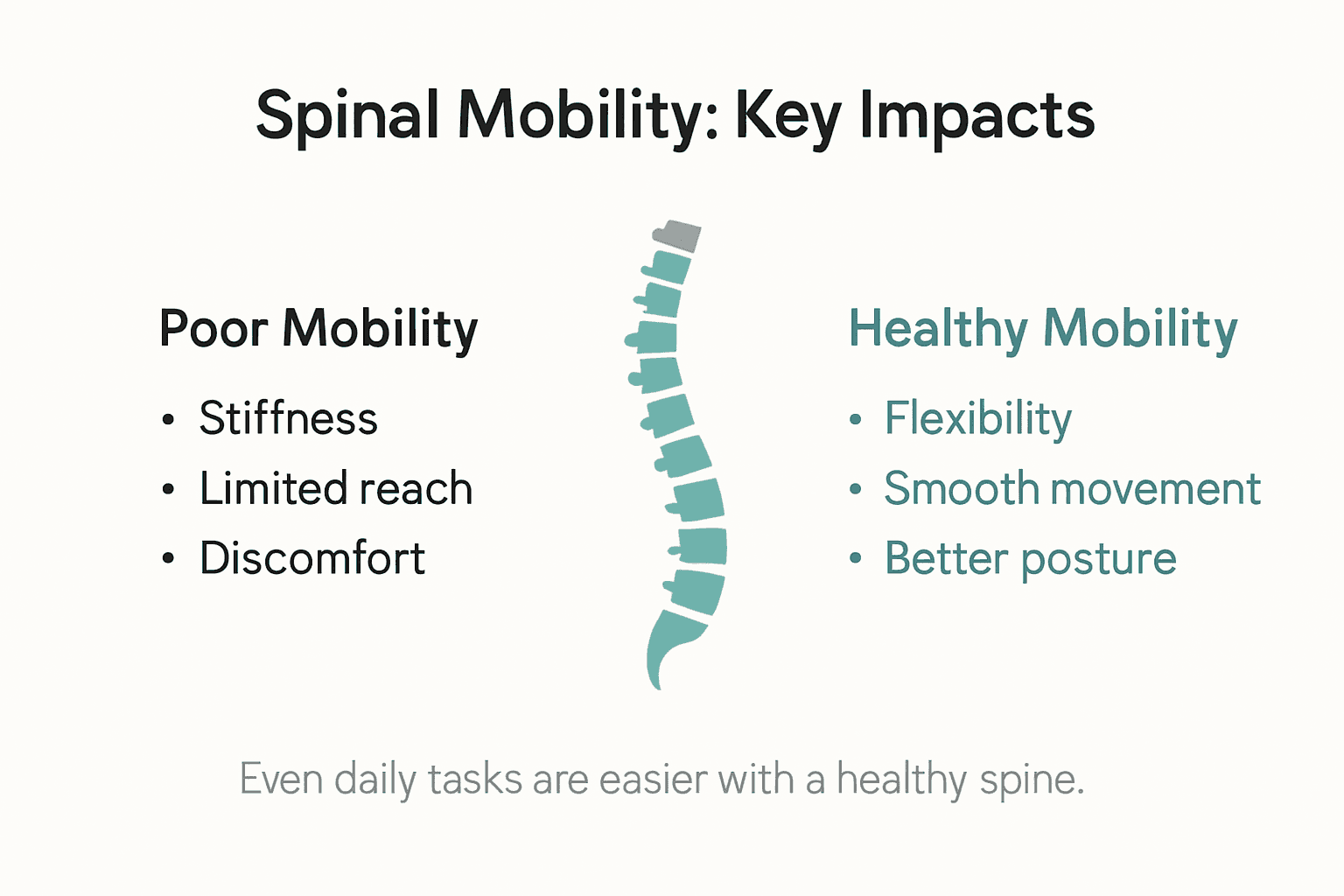
Pro tip: Integrate gentle spinal mobility exercises into your daily routine, such as cat-cow stretches or seated rotational movements, to maintain flexibility and prevent stiffness.
Risks of poor mobility and common mistakes
Poor spinal mobility can lead to significant health challenges, with invasive treatments carrying substantial risks and limited long-term benefits. Many individuals unknowingly develop movement patterns that progressively compromise their spinal health, creating a cycle of increasing dysfunction and potential chronic pain.
In North Fremantle’s active community, common mobility mistakes include persistent poor posture, neglecting regular stretching, and overcompensating during physical activities. Weekend warriors and office workers often develop muscle imbalances by maintaining static positions for extended periods, which gradually reduce the spine’s natural range of motion. Musculoskeletal health directly impacts active lifestyle performance, making it crucial to address mobility restrictions before they become entrenched movement patterns.
The most significant risks of poor spinal mobility include increased injury susceptibility, reduced physical performance, and potential long-term structural changes. When the spine cannot move efficiently, surrounding muscle groups must work harder, leading to compensatory movements that create additional strain. This can result in a cascading effect of biomechanical challenges, potentially causing issues in joints, muscles, and overall movement quality.
Compare the key risks of poor spinal mobility with the benefits of a healthy, mobile spine:
Aspect | Poor Spinal Mobility | Healthy Spinal Mobility |
Injury Risk | Increased susceptibility to strains and sprains | Reduced likelihood of acute or chronic injury |
Daily Function | Difficulty with basic movements, greater fatigue | Efficient movement and less energy expenditure |
Postural Health | Leads to imbalances and persistent poor posture | Supports balanced, upright posture |
Long-term Consequences | May cause lasting structural changes in joints | Promotes sustained musculoskeletal wellness |
Pro tip: Conduct a weekly mobility self-assessment, paying attention to any restrictions or discomfort during basic movements like bending, twisting, and reaching.
Practical ways to improve spinal mobility
Spinal mobilisation techniques offer gentle, controlled approaches to enhance flexibility and reduce joint stiffness. These methods involve targeted movements designed to gradually improve range of motion, helping individuals restore natural spinal function and reduce discomfort without aggressive interventions.
In North Fremantle’s active community, practical mobility improvement strategies include a combination of targeted exercises, professional chiropractic assessments, and mindful movement practices. Posture correction techniques play a critical role, as proper alignment reduces unnecessary stress on spinal structures. A comprehensive approach might involve daily stretching routines, dynamic mobility drills, and strength training that emphasises core stability and balanced muscle development.
Research suggests that systematic somatic movement interventions can dramatically improve spinal range and functional mobility, particularly for individuals experiencing reduced baseline performance. This involves intentional, controlled movements that gradually expand the spine’s capacity for flexible, pain-free motion. Key practices include cat-cow stretches, controlled rotational movements, and specific mobility exercises that target different spinal segments and movement planes.
Pro tip: Dedicate 10 minutes daily to targeted spinal mobility exercises, focusing on gentle, controlled movements that explore your current range of motion without causing discomfort.
Unlock Your Spine’s Full Potential with Expert Care
If spinal mobility challenges are holding you back from moving freely and performing at your best, it is time to take action. Whether you are a weekend warrior feeling the strain from poor spinal rotation or a parent struggling with daily activities due to stiffness and limited flexibility, targeted movement-based care can restore your spine’s natural function. At North Fremantle Chiropractic, we understand how critical a healthy, mobile spine is for pain-free living and peak performance.
Discover how our elite sports-focused chiropractic care combined with real-world strength and conditioning principles can help you build resilience—not just fix pain. Don’t let restricted spinal mobility limit your agility, strength, or daily comfort. Start your journey to better movement and improved performance today by visiting North Fremantle Chiropractic, learning more about how to maintain spinal health naturally, and experiencing the benefits of performance chiropractic techniques. Your spine deserves care that empowers your lifestyle and sport. Make your next move your best move now.
Frequently Asked Questions
What is spinal mobility and why does it matter?
Spinal mobility refers to the spine’s ability to move and function across different planes of motion, including flexion, extension, lateral flexion, and rotation. It plays a crucial role in everyday activities and athletic performance.
How does spinal mobility affect athletic performance?
Optimal spinal mobility enhances movement efficiency, allowing athletes to generate power, change direction quickly, and reduce the risk of injuries. Poor mobility can lead to compensatory movements and increased energy expenditure, hindering performance.
What are some effective exercises to improve spinal mobility?
Gentle spinal mobility exercises like cat-cow movements, controlled thoracic rotations, segmental spinal flexion and extension drills, and progressive loading strategies can improve movement capacity over time. At North Fremantle Chiropractic, we assess how your spine moves under load and tailor mobility strategies based on your training demands and injury history.
What are the risks associated with poor spinal mobility?
Poor spinal mobility can lead to increased injury susceptibility, reduced physical performance, and long-term structural changes in joints. It can create compensatory movement patterns that may cause chronic pain and fatigue.
WHEN SHOULD I SEEK HELP FOR LIMITED SPINAL MOBILITY?
If you notice recurring stiffness, reduced range of motion, difficulty rotating or bending, or repeated injuries in training, it may indicate an underlying mobility restriction or load management issue. A proper assessment can determine whether the issue is mobility, stability, strength, or movement coordination related.
CAN SPINAL MOBILITY IMPROVE GYM OR SPORT PERFORMANCE?
Yes. Efficient spinal motion allows better force transfer between the upper and lower body. This can improve lifting mechanics, rotational power, sprinting mechanics, and change-of-direction efficiency. Targeted mobility combined with strength and conditioning strategies delivers the best long-term performance outcomes.
Recommended
Comments